


This year’s Colorado ballot is long, complicated, and consequential. After several requests for help, I wrote a voter guide, omitting candidates so readers would consider my recommendations without a partisan lens.
A friend forwarded it to a group and one of its members replied to everyone that he disagreed with me.
What followed was a constructive exchange over evidence and constitutional principles. Becoming blunt, as he put it, he pointed out where I live and asked a series of personal questions:
“Who’s funding you?”
“What’s your party?”
“Who are you voting for?”
I told him I welcomed questions about my ballot recommendations but rejected the idea that arguments should be judged by someone’s hometown, party affiliation, or presumed motives.
There was one question I never answered. I want to answer it here because it goes to the heart of the midterm election.
While we were debating Colorado’s ballot, French protesters were asking a similar question in the streets.

Why is France Ablaze?
Like bankruptcy, France’s crisis developed gradually, then suddenly.
With one of the most generous welfare systems in the world, France faces mounting debt, rising interest costs, and an economy too stagnant to make good on past promises, never mind new demands.
Consider pensions, where projected obligations exceed income as people live longer amid declining birthrates. In 2023, President Macron tried to address the shortfall by gradually raising the retirement age from 62 to 64. Facing opposition, even this modest reform was suspended.
The costs now fall on the young who are financing commitments made before they were born, even as their economic prospects wither.
Absent fiscal reform, France needs economic growth to create jobs, boost wages, and generate the tax revenue to meet unfunded obligations without imposing an even greater burden on future generations. Unfortunately, with youth unemployment well above the EU average, France is struggling to generate the growth needed to finance its commitments.
France’s fiscal crisis is exacerbated by a crisis of social cohesion resulting from mass migration without assimilation, though the problem extends beyond immigration. Both native-born and immigrant French youth have marinated in a culture in which Western civilization is viewed as something to apologize for rather than an inheritance from which to learn and take pride.
This month, a widely shared video captured young people desecrating a French church while singing lyrics that praise the jihadists who perpetrated the Bataclan massacre and the 2012 Toulouse murders.
As Konstantin Kisin observed, “If you spend decades teaching your children to hate their own society, why would you be surprised that they then hate their own society?”
Caught between the street mob and the bond market vigilantes, France teaches us that promises made in the name of fairness become unjust when the economy can’t sustain them. And no country can cohere without a shared commitment to its laws and values.
Sound Familiar?
America could suffer the same fate. Our national debt exceeds $40 trillion, and Washington continues borrowing roughly $2 trillion a year despite collecting a record $5.4 trillion in taxes.
Interest on that debt exceeds $1 trillion annually—more than the national defense budget—a sign America “risks ceasing to be a great power,” according to historian Niall Ferguson.
Thankfully, US economic growth has kept us from becoming France. The latest figures show our economy growing at a 3.4% annual rate, while France’s shrank. But growth can’t save us if spending continues to outrun it.
Recently, Bill Maher, no conservative, captured the predicament for future generations: “We have to stop robbing tomorrow because we’re paying so much for yesterday.”
Meanwhile, as Americans struggle with the cost of living, candidates in the midterms are making similar promises: Government can make life affordable by providing more of what families need.
When Affordability Promises Backfire
The Democratic Socialists of America’s platform claims the government can provide housing, health care, childcare, education, and more, paid for by “the richest individuals and corporations.”
Before accepting their promise, consider which things have become harder to afford, and why.
This chart from economist Mark Perry is telling:
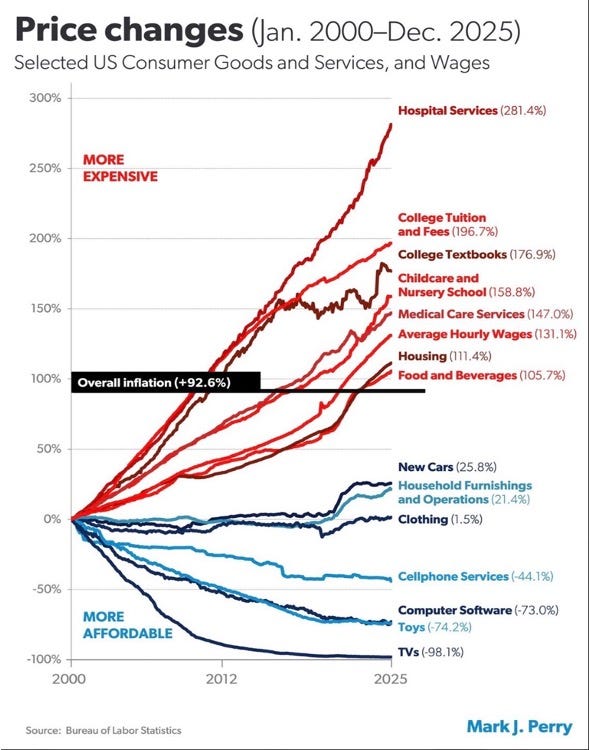
As Perry’s chart shows, since 2000, products sold in highly competitive, innovative markets — electronics, software, furniture and clothing — have become cheaper. But the more regulated, subsidized sectors — hospital services, college tuition, and childcare, all things Americans are struggling to afford — have gotten progressively more expensive.
So, when socialists promise to make something more affordable, shouldn’t we ask whether their policies will actually lower costs?
Consider housing. When government regulates construction thereby restricting the supply of new homes, while also subsidizing buyers, prices are forced higher, pricing out those who can least afford it.
To understand rising higher education costs, recall that government-backed student loans increase demand, incentivizing colleges to charge more without losing students.
Regarding spiking health care costs, remember that government subsidies increase demand, while regulations limit the supply of medical services, leading to higher costs.
This isn’t about loving markets or hating government but questioning what will make life more affordable. The economy isn’t a fixed wealth pie waiting to be divided. It grows when entrepreneurs, workers, and investors create things like refrigerators, mobile phones and medicines that improve people’s lives.
As France’s less innovative economy testifies, when government becomes the default solution, we risk sacrificing the innovation that enhances our living standards and the freedom to make decisions that shape our lives.
California: Where “Temporary” Means Permanent
As Macron’s failed pension reform demonstrates, government programs create constituencies that resist their being scaled back. California also has entrenched constituencies.
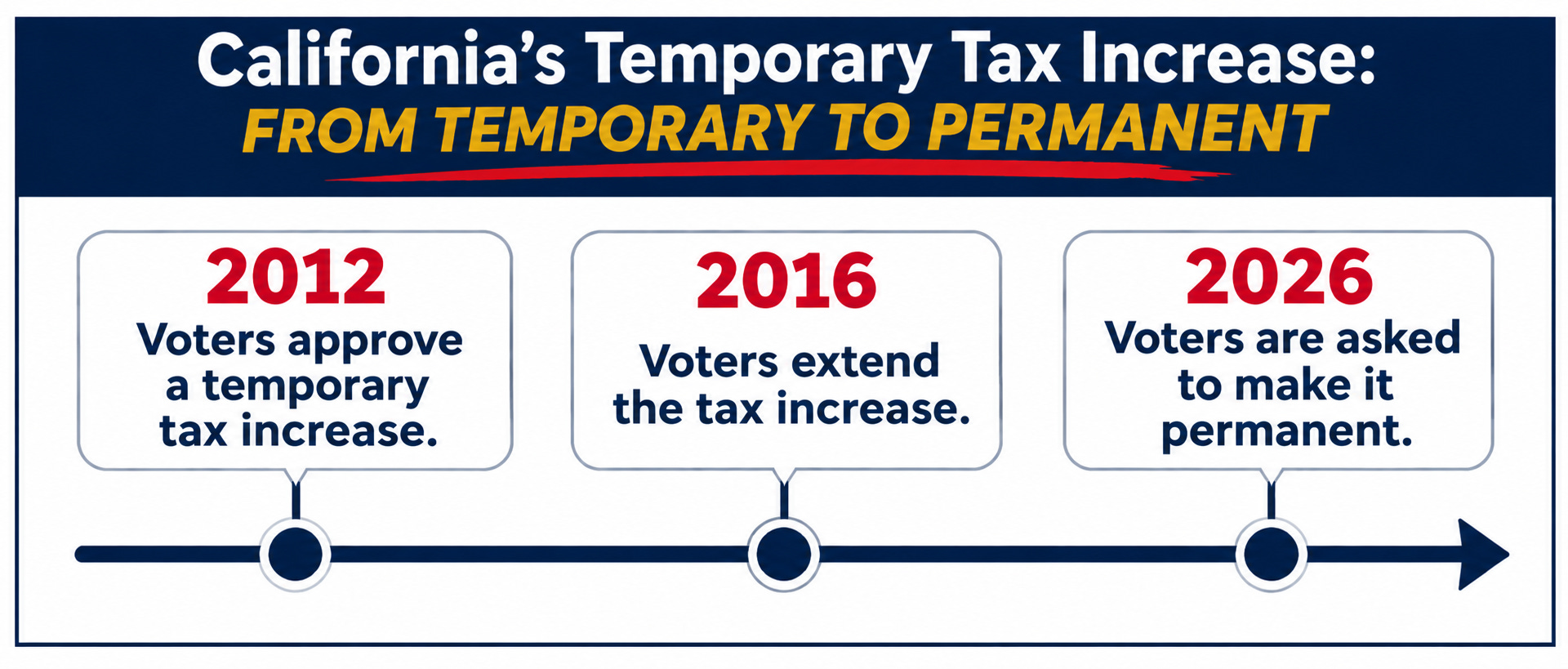
In 2012, voters approved a “temporary” tax increase on high earners. In 2016, they extended it. Proposition 3 on California’s ballot now asks voters to make it permanent.
Meanwhile, more Californians are leaving the state than moving in, shrinking the tax base available to support its increasing obligations.
On California’s ballot is a new wealth tax which even Gov. Gavin Newsom opposes, warning that wealthy residents will move, taking their tax revenue with them.
California illustrates how government commitments become difficult to reverse, especially when the taxpayers on which they depend can take their leave.
Colorado, for now, has a brake on that ratchet. And on Tuesday, voters will decide whether to release it.
Colorado: Fairness Means the People Have the Final Say
That brake is Colorado’s Taxpayer’s Bill of Rights (TABOR), adopted by voters in 1992. Based on the constitutional principle that the government is accountable to the people, it requires voter approval for tax increases and limits how much revenue the state can keep, with the excess refunded to taxpayers.
Importantly, the government can still raise taxes; it just requires lawmakers to persuade the people who pay them, regardless of which party is in power.
Together with Colorado’s flat income tax, TABOR helped make our state attractive to businesses and families fleeing high-tax states like California. But as lawmakers have increasingly circumvented TABOR by imposing fees rather than taxes, and by layering on costly regulations, Colorado has lost its competitive edge.
Consider Palantir. In 2020, the high-tech firm left Silicon Valley for Denver where it became Colorado’s largest public company. Just six years later, Palantir moved its headquarters again, to Miami.
Palantir isn’t the only warning sign. In 2026, Colorado fell from 11th to 17th in U.S. News & World Report’s Best States rankings and from 11th to 25th in CNBC’s Top States for Business.
On election day, Colorado voters will decide whether to weaken or safeguard what helped make our state one of America’s best places to live.
The most controversial measure on the ballot is Amendment 87, which would replace Colorado’s flat income tax with graduated rates reaching 8.4%. Sold as a tax cut, the most anyone would receive is $325, while future generations face substantially higher taxes.
Even Democratic Gov. Jared Polis opposes it, calling it “a blank check for politicians” that would “seriously hurt our economy and raise prices on everything.” On Friday, Colorado Attorney General Phil Weiser, the Democratic nominee for governor, also announced his opposition to 87.
Adding insult to injury, the tax brackets aren’t adjusted for inflation. As Coloradans’ incomes rise with inflation, many taxpayers will eventually pay higher rates even without any increase in purchasing power.
And by exempting the additional revenue from TABOR’s limits, Amendment 87 would give politicians greater control over taxpayers’ money—making us more like California.
Another ballot measure, Amendment 81, was the focus of my exchange with my critic. It would require local police to notify federal immigration authorities when someone charged with a violent or repeat crime is either here illegally or has unknown immigration status.
I argued that Amendment 81 would enable protective compassion. Equal application of the law is a basic tenet of a free and fair society. When rules are enforced unevenly or not at all, it’s not only unfair, but the most vulnerable often pay the highest price.
The Fairness Question I’ll Now Answer
In the email exchange with my critic, the question I never answered was: Should the wealthy pay their fair share?
Of course. The harder question is how to define fairness.
Who pays, and how much, is part of the answer, particularly when some can afford lawyers and accountants to minimize their taxes while others cannot.
Shouldn’t we also measure fairness by what government delivers, the opportunities it creates or destroys, the burdens it places on future generations, and whether citizens retain the power to hold it accountable?
Measured this way, many promises made in the name of fairness can be profoundly unfair. Just as young French protesters inherited their government’s unfunded promises, future generations of Americans will inherit obligations they never agreed to.
We can still choose otherwise.
But that will require examining evidence, questioning promises, and holding government accountable, even when accused of being unfair.
My critic and I didn’t resolve our differences, but we engaged respectfully, encouraging the group following our exchange to research the issues and make their own judgments.
That is self-government, and perhaps the greatest obligation we owe future generations: not promises they will have to pay for, but the freedom to make their own choices.
Now go vote! And if you’re voting in Colorado, here’s my 2026 Colorado Voter Guide.
Timely article and nonpartisan Mass has a ballot question that limits taxation and requires excess revenues be returned to the taxpayers. Our legislature has a history of ignoring the will of the populace by passing legislation that blunts favorable laws already on the books. Not long ago the voters by 72% voted to allow an audit of the state legislature The legislature has decided to ignore this. This is what happens in a one party state. Mass is overwhelmingly democratic so the legislature does what it pleases without repercutions. Colorado certainly seems to be heading in that direction unfortunenately.