


As a proud University of Southern California graduate, my mother‑in‑law has long viewed the Fighting Irish the way most Trojans do: with a mix of respect, rivalry, and a wish for a better win‑loss record.
So her glowing review of our son’s graduation weekend at Notre Dame was as genuine as it was surprising. She was enchanted by the campus, the students, and the commencement speakers.
Most surprising to her, though—especially given chaotic graduation scenes elsewhere—was what was missing: no pink-haired protestors waving placards, no partisan diatribes, no students booing speakers. Instead, there were messages of hope, human dignity, personal responsibility, and service to others.
After returning home, she remarked, “I feel like I’m floating on Cloud 9.”
The truth is, so were we.
We were proud that our son Zane was graduating and heading to Officer Candidate School to become a Navy pilot—a dream that began when he was a toddler, pointing excitedly at airplanes overhead.
But mostly, we were grateful. And I thought I knew why.
I was grateful for the education Notre Dame had given him, the friendships he’d formed, and the welcoming community he found there as a Jewish student when so many other campuses weren’t.
Days later, I discovered Sean Trende’s beautiful essay about his profoundly autistic son Judson’s final school bus ride. Reading it aloud to my husband, we both fought back tears—not because Judson’s life is tragic, but because Sean captured perfectly the hopes, fears, disappointments, and unexpected joys of parenting.
It exposed the real source of our gratitude. And it wasn’t really Notre Dame – it was everything that had happened before.
When Obstacles Become Opportunities
Among the most gripping lines in Trende’s essay is his reflection on the moment his world changed, when Judson – now 18 – was three:
“...we went into a doctor’s office wondering whether our son might one day be president. We walked out wondering if he would ever potty train.”
Their challenge was far greater than ours, yet I felt a sharp pang as memories of Zane’s educational assessment flooded back.
When Zane was seven, we had him undergo a comprehensive educational evaluation because, as his teachers described, he wasn’t “flourishing.” As we listened to the evaluator’s conclusions, I felt devastated. My husband remembers wanting to throw the clinician out the third-story window.
His assessment was discouraging: extensive recommendations and a cautious outlook.
But an evaluation isn’t a verdict. It was a snapshot of a seven-year-old boy, not a blueprint of the man he’d become.
When Zane’s tutor, Bob Stewart—an experienced special education teacher—read the assessment results, he said,
“Throw it in the garbage.”
He wasn’t ignoring Zane’s struggles. Zane definitely needed reading help. What Bob rejected was the idea that the evaluation captured the child he knew.
Zane’s principal and teachers agreed:
“This isn’t Zane.”
What the evaluation didn’t capture was a boy captivated by airplanes from the moment he first spotted one from his stroller. And it certainly didn’t describe his future.
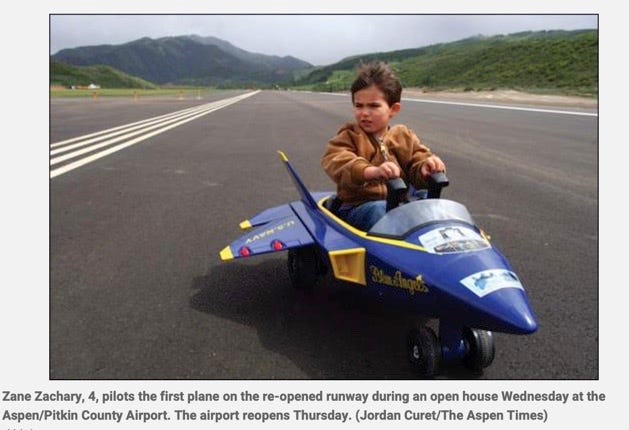
We discarded the evaluation. The fears, however, lingered. Tests can identify challenges, but they can’t measure grit, determination, or spirit. And they can’t predict what happens when a child discovers a purpose so compelling that he becomes willing to do hard things in pursuit of it.
As parents, we often assume our greatest gift to our children is helping them avoid obstacles. I now believe the greater gift is helping them discover that they’re capable of overcoming them.
A Reason to Try
In Trende’s telling, when a teacher asked Judson what he wanted to be when he grew up, he answered simply:
“A good boy.”
Trende describes Judson as “a gentle, loving soul who never gossiped, never insulted anyone, never lied.”
Judson’s dream was simple and profound: to be a good boy. Zane’s was concrete and unwavering: he wanted to fly.
While other children played with dinosaurs, superheroes, or fire trucks, Zane remained singularly focused. Every airport trip ended with another airplane model. “Good boys get toys” became my favorite motivational slogan. Fortunately, nothing motivated Zane more than airplanes.
Then an opportunity arrived. In third grade, our school district hired Greg Roark to launch an aviation program. Students trained on real flight simulators and could earn a pilot’s license while still in high school.
After meeting Zane, Greg immediately recognized that he wasn’t merely interested in airplanes—he was motivated by them. He often showcased Zane as an example of what the program could inspire.
Like Bob Stewart, Greg saw Zane’s possibility. More importantly, he helped Zane see a path connecting what he needed to do today to what he wanted someday. Suddenly, the academic support Zane once viewed as embarrassing became a tool for pursuing the future he wanted.
None of this happened overnight. There were still tears, frustrations, and moments he wanted to quit—when I’d remind him that his mind was like a parachute; it only worked when it was open.
But something fundamental had shifted. Zane had found a reason to open his parachute.
Where Confidence Comes From
By eighth grade, Zane no longer needed reading support and was testing above grade level in reading. Much of the credit belongs to Dawn Lamping, who succeeded Bob Stewart. What began as tutoring in reading evolved into mentorship. Dawn challenged Zane’s thinking, sharpened his writing, and taught him to engage seriously with ideas.
Reflecting on his journey at middle school graduation, Zane told his classmates:
“Every person in this room today has and will again endure something that is hard and challenging. The question is, how will we react? I didn’t choose to be dyslexic; no one chooses their hardships in life. But we can work hard, overcome our challenges, and become better people from them.”
He added:
“My disability gave me a chance to prove that I could overcome adversity, and overcoming obstacles helped me build my confidence….The truth is, with each obstacle you overcome, and accomplishment you attain, you will grow more confident, determined and willing to take risks in pursuit of your goals.”
Video of Zane’s Middle School graduation speech: Lessons learned from dyslexia
What Education Is For
Reading Trende’s essay, I was struck by how many “everyday heroes” Judson encountered—people who saw possibility, not limitation. They helped him participate in choir, Special Olympics, pep rallies, homecomings, and prom—and were inspired by him in return.
Trende writes that whenever he hears This Little Light of Mine, he thinks of his son “sending sparks of light everywhere he’s gone.”
Zane was fortunate to have a few everyday heroes as well. What he cultivated with their help was deeper than proficiency. It was self-discipline, perseverance, and the confidence that comes from overcoming obstacles.
Years later, I learned that behavioral scientists had observed something similar.
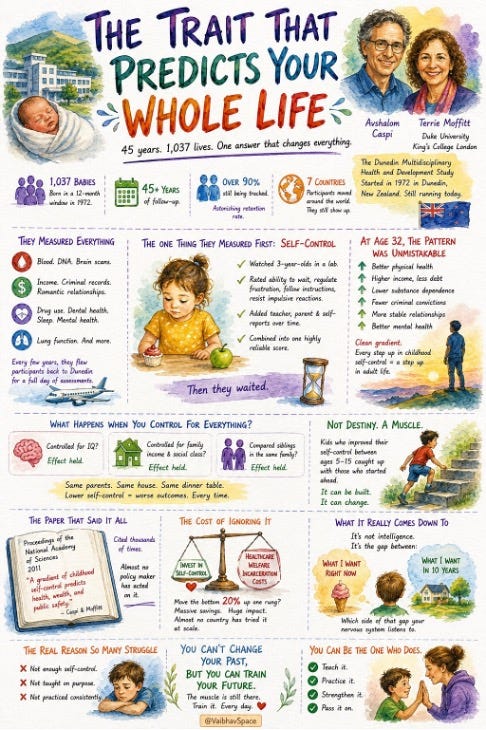
The New Zealand Dunedin Multidisciplinary Health and Development Study has tracked 1,037 children since the early 1970s. Researchers discovered that a child’s level of self-control — measured by their ability to wait, regulate emotions, and follow through — was one of the strongest predictors of adult flourishing, even after accounting for intelligence and family wealth.
The pattern held across health, wealth, criminal behavior, and relationships. More encouraging still, self-control is not fixed. Like a muscle, it can be strengthened.
Beyond benefiting individuals, they estimated that if a nation could increase the self-control of its bottom 20 percent, healthcare spending, welfare dependency, and incarceration rates would all improve.
Looking back, I can see why.
After discovering something worth striving for, Zane became willing to do difficult things. And the habits that helped him overcome his reading challenges later helped him earn an International Baccalaureate diploma, obtain his pilot’s license, graduate from Notre Dame, and continue pursuing his dream of becoming a Navy aviator.
What the adults supporting both Judson and Zane understood—and what the Dunedin study confirmed—is that education is about helping children develop the habits, character and confidence necessary to flourish.
Not by lowering standards. By raising support. By helping young people discover they are capable of more than they thought.
Or, as Zane put it, to overcome obstacles and become better people because of them.
What Makes This Harder Today
Today’s kids have serious obstacles. Consequently, national reading and math scores started declining long before COVID. Professors report that many students now arrive on campus needing remedial work. Meanwhile, young people are immersed in social media and increasingly reliant on artificial intelligence, both of which can displace the hard work of thinking.
In his recent TED Talk, Jonathan Haidt argues that this may be our youth’s central challenge. The problem isn’t simply that smartphones consume time. They fragment attention and make it harder to cultivate the habits that allow human beings to flourish: sustained focus, self-control, perseverance, and the capacity to wrestle with ideas long enough to form independent judgments.
Parents are understandably anxious about outcomes—as we were during Zane’s educational assessment years ago.
But Judson’s story and Zane’s suggest a different lesson. Parents cannot control admissions policies, standardized testing trends, or their children’s digital ecosystem. Nor can they control the evaluations, report cards, or predictions their children receive.
But they can shape what matters most: their children’s habits, character, capacity for self-control, and willingness to do difficult things in pursuit of worthwhile goals. These qualities are the foundation upon which meaningful lives are built.
Education, at its best, is formation, not information.
That is the important lesson graduation season has taught me: becoming is more important than predicting.
The Pursuit of Happiness
In his essay, Trende shares his most important lesson from parenting Judson:
“A less-than-perfect life is still very much worth living….We just want our kids to be happy, and Judson is the test case for that. He won’t go to college, he won’t work a job, and he’ll almost certainly die without having ever kissed a girl. But as he walks down the hall, you realize that he doesn’t have a care in the world. He’s almost always happy.”
Trende closes his essay by recalling lines from the children’s books he read to Judson:
“Judson, just know that while it might not always seem like it, you’ve made this tree so happy. Daddy loves you (and Mommy too!), all the way to the moon and back.”
Pursuing happiness clearly isn’t for sissies, to paraphrase the title of Peggy Noonan’s latest Wall Street Journal column. She too was handed a verdict by a guidance counselor who told her she wasn’t college material. Last week, while receiving an honorary doctorate at Harvard, she savored that memory.
At Notre Dame’s commencement ceremony, Special Olympics CEO Timothy Shriver received the Laetare Medal, the university’s highest honor. In his address, he challenged graduates to honor “the inherent dignity in every human being” and help “renew the face of the earth,” before sharing a story of a Special Olympics athlete.
Donal Page’s challenge was to move a bean bag across a table. Seconds stretched into minutes. First there was silence. Then encouragement. Then cheering. Then shouting. Then tears.
Shriver joked:
“Now I know you all have been in sporting events where there was a lot of bedlam, but I promise you, you haven’t seen an athlete as great as Donal Page.”
These stories—Judson, Peggy, Donal, and Zane—clarify what America’s founders meant when they wrote that all people are created equal and endowed by their Creator with the right to pursue happiness.
They didn’t mean a life without obstacles, discouraging evaluations, or setbacks. They meant one in which every person, possessing inherent dignity, is given enough support, encouragement, and community to move their own bean bag across the table.
Not every child will become a Navy pilot or receive an honorary doctorate or even earn a diploma.
But every child deserves the opportunity to become who they are capable of becoming.
That is a pursuit of happiness worthy of a great nation, and of the children who will inherit it.
Wow, Melanie! Beautifully written and inspiring content. Congratulations to Zane - and to you and Zac. I’m happy for all of you for what the future may bring.
Melanie, this is so beautiful and important. Your best work yet! Amazing!