

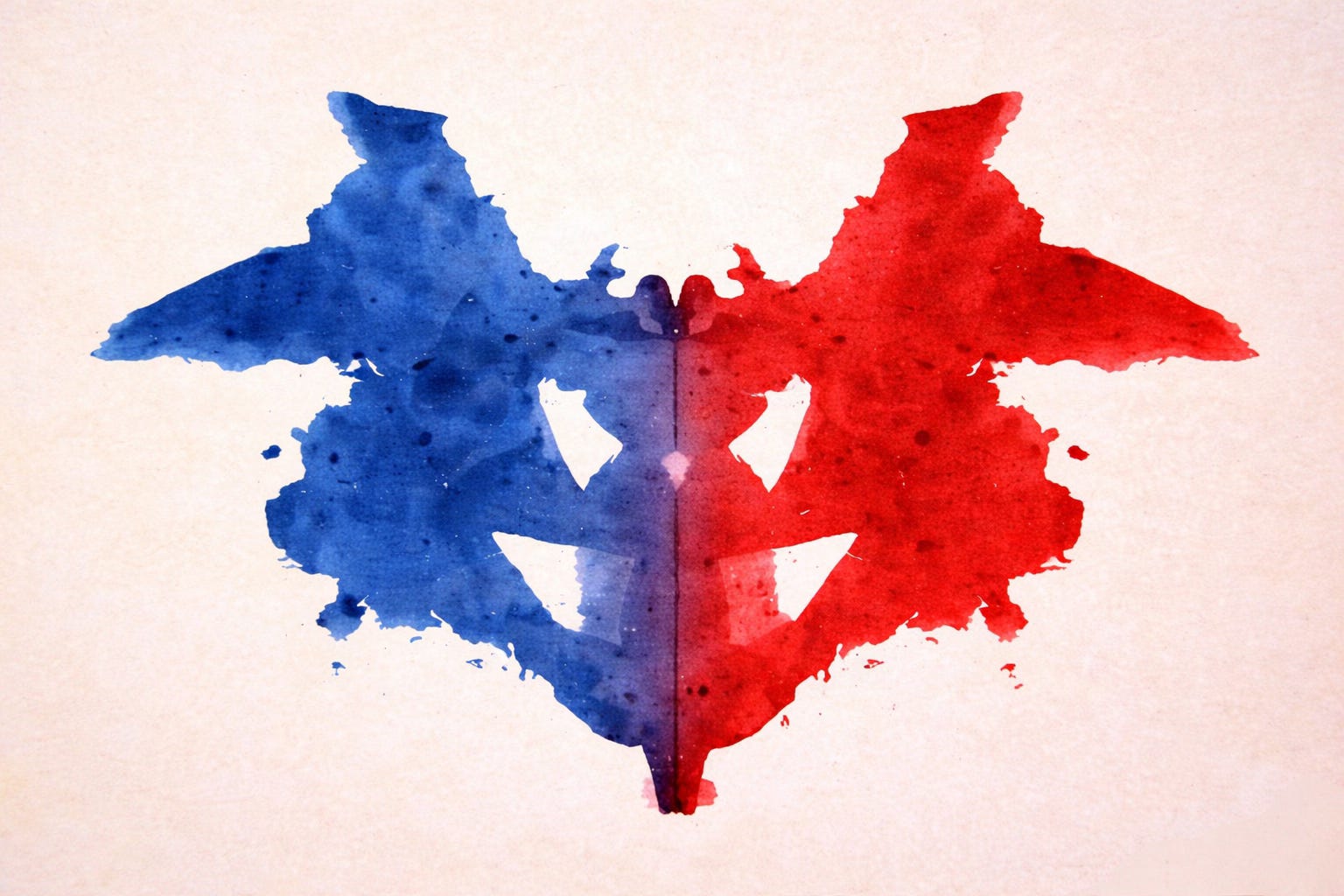
We are living through a Rorschach moment. We look at the same ink blots — the border, Epstein, gender medicine — and swear we’re seeing opposite realities.
I was reminded of that recently when I found myself seated next to a gentleman at a luncheon. We discovered easy common ground: he grew up in Indiana, I grew up in Nebraska. We traded a few jokes about Hoosiers and Huskers swapping basketball and football fortunes.
Then the conversation turned to Indiana’s former fiery basketball coach Bobby Knight, whom he idolized growing up. “Now,” he said, “I despise him.”
Bewildered, I asked why. If he admired Knight when he was throwing chairs and choking players, what changed?
His answer startled me.
“Because he supported Donald Trump,” he said. “That reflects poorly on his character.”
I asked, gently, whether he felt the same about the 81 million Americans who voted for Trump.
“Yes,” he replied, without hesitation.
Trying to keep things light, but unsettled by the shift from disagreement to disqualification, I said,
“Well, that’s very Martin Luther King Jr. of you.”
He smiled sheepishly and our conversation moved on.
The MLK Test
That conversation stayed with me because it posed a question I can’t escape. Call it the MLK Test: if we only demand principles when they help our side win, they’re not principles — they’re weapons.
King urged us to judge by character, not by color. Increasingly, we judge by the color of a ballot.
I’m not picking on him—he’s expressing a temptation we all share. Trust collapses, and political allegiance becomes a moral X-ray: their votes reveal rotten character; ours never do. We’re staring at the same ink blot, seeing only what we want.
The MLK Test isn’t a weapon to wield against others. It’s a question we must answer for ourselves.
The Rorschach Pattern in Our Debates
The pattern leaps from every news feed: ICE is fascism incarnate. Or ICE is besieged by sinister forces bent on open borders. The Epstein files expose a partisan conspiracy. Or they prove an international sex-trafficking ring. Pediatric gender medicine is unquestionable life-saving care. Or it is systemic malpractice.
Each side can point to fragments that confirm its view. Outrage races ahead of evidence. Suspicion outruns facts. When standards bend to fit preferred outcomes, trust frays – not just in institutions, but between us.
The real test comes when those same ink blots appear in places of real power – at the border, in elite circles, and in doctors’ offices.
Immigration and Equal Standards
I saw how fragile equal standards can become when I served as foreman in a DUI trial. I expected a quick not-guilty verdict because the judge was clear: distinguish between drinking and driving, which is legal, and driving under the influence, which requires proof beyond a reasonable doubt.
Yet three jurors wanted to convict anyway, despite devastatingly contradictory evidence. The officer had testified that the defendant steadied herself drunkenly on the car door – though his own body-cam footage showed otherwise. One juror deferred to the badge; the others assumed that two drinks meant impairment.
I asked: If we relax “innocent until proven guilty,” what protects us?
We ultimately settled on a lesser charge. I left unsettled — the scales had tipped, as if Lady Justice had lifted her blindfold to glance at something other than the evidence. Ironically, the statue atop our courthouse is one of the few that isn’t blindfolded.

That same drift away from evidence shows up in our immigration fights.
When protesters surround ICE facilities, swarm agents’ vehicles, or confront clergy they associate with enforcement, they invoke the moral aura of “civil disobedience.” But as King reminded us, true civil disobedience accepts legal consequences to expose injustice. It does not exempt itself from the law while obstructing others.
After my Minneapolis post last month, even critics agreed on its premise: a
just society demands equal enforcement. Where we differed was on trust. Many
see ICE as Gestapo-like. That reaction reflects how deep suspicion of state
power runs.
If someone dies during a chaotic encounter and your stomach doesn’t knot, something in us has gone numb. Americans should never grow numb to force exercised in their name.
Order through law requires reform pursued through legislation — not through obstruction, intimidation, or executive fiat. In the wake of two killings by ICE, bipartisan proposals have emerged to require body-worn cameras, strengthen training, and increase transparency.
At the same time, immigration battles have stalled broader funding negotiations, with disaster relief and airport security caught in the crossfire. When essential services for ordinary citizens become leverage in enforcement disputes, trust erodes. That is not accountability; it is dysfunction.
Reform can strengthen enforcement; brinkmanship undermines it and erodes public confidence. A free society resolves disputes through even application of the law — not by shielding favored policies from scrutiny or by placing unrelated public goods at risk.
The same question follows power wherever it goes — from the border to the boardroom.
Epstein and Elite Power Under the Rorschach Lens
If immigration exposes our fears about state power, Jeffrey Epstein exposes our fears about elite power. For many Americans, the lesson feels blunt: there is one set of rules for billionaires and princes, and another for everyone else.
The release of millions of pages of “Epstein files” intensified that suspicion. Allegations, emails, contact lists, photographs — raw material was poured into public view. Some victims were reportedly insufficiently redacted. Yet the release answered few core questions about money, methods, or network. It added names, but not clarity.
Under the Rorschach lens, that kind of disclosure becomes an ink blot. One person sees proof of a partisan cover-up. Another sees confirmation of a global blackmail ring. A third sees what they always suspected: proximity to power functions as protection. Each camp can point to fragments — a dinner here, a photograph there — and construct a narrative that becomes difficult to falsify.
You do not need a CIA screenplay to explain why people orbited Epstein. You need human nature and the strange economy of access.
Years ago, I knew a banker who rocketed to prominence by cold‑calling influential people he didn’t know to offer introductions to other influential people he didn’t know. With a thin veneer of proximity, he became the man who could open doors.
Scale that up — add a private island, enormous wealth, and celebrity guests — and it’s easier to see why people still orbited Epstein after his 2008 conviction. Access is intoxicating. Status is addictive. And humans are remarkably skilled at rationalizing what they would condemn in others.
I have also seen, at a much smaller scale, how proximity to valuable information tempts people to disregard rules. Early in my finance career, I was swept into an insider‑trading investigation as a witness. But someone near sensitive information had used just enough of it to help a friend profit. It was small by Wall Street standards — but it exposed how easily people near power blur lines.
“Everyone does it.”
“It’s technically legal.”
“No one will know.”
I learned that corruption often begins not with monsters, but with rationalization.
The truth about Epstein is chilling enough. He trafficked underage girls. He remained socially acceptable in circles that would never tolerate a registered sex offender next door. He died in federal custody under circumstances that still invite questions.
We know that very powerful people exercised grotesquely poor judgment in maintaining contact with him after his first conviction. But what the files have not established — despite breathless speculation — is the legal culpability of a sweeping roster of elites.
This is where the MLK Test becomes uncomfortable. Equal standards mean we cannot ruin elites on unproven allegations any more than we would tolerate that for an ordinary citizen. A just society must investigate thoroughly, prosecute only when evidence warrants, and protect victims from further harm — not fall prey to moral panic by declaring people guilty of wrongdoing simply because of their associations.
Not every moral failure is a crime, but that does not mean it escapes justice. In a functioning society, power carries consequences — sometimes not in a cell, but in the loss of status, office, and trust.


Prince Andrew has lost title and standing. Larry Summers, Kathy Ruemmler, and Peter Attia stepped away from prestigious roles. Bill Gates publicly apologized and saw his reputation battered. The reckoning has been global.
This is how a culture disciplines itself. When the high and mighty lose money, titles, and influence for reckless proximity to corruption, others recalibrate. Access is not worth the cost.
When I was in college, I once shared a hotel room at a conference with a male friend — purely platonic. My father was furious. He didn’t care what had or hadn’t happened behind the door. He cared about the appearance.
“Reputation, once questioned, is hard to reclaim,” he warned.
That lesson applies at scale. A society becomes more just not only when criminals are prosecuted, but when incentives change — when elites understand that even the appearance of indifference can cost them everything. That is how trust is rebuilt: not by spectacle, but by equal standards and visible consequences.
If the Epstein saga tests our commitment to equal standards in the face of elite power, the controversy over gender medicine tests whether those standards apply when experts claim moral certainty.
Gender Medicine and Evidence Standards
In my post last year — What I Learned in My Theater Board’s Gender Debate — I described fighting a pronoun policy for a children’s theater program. I persuaded the board to change it, but not before being labeled a transphobe by a staff member citing medical papers asserting that gender-affirming care was “evidence based.”
Earlier this month, the American Society of Plastic Surgeons and the American Medical Association announced they no longer back that consensus. They now describe the evidence for gender-related surgeries on minors as “insufficient and of low certainty,” recommending deferral until adulthood.
That reassessment did not happen in a vacuum. It followed litigation — including a New York jury’s $2 million malpractice verdict awarded to Fox Varian, a 22-year-old who underwent a double mastectomy at 16 and later argued she had not received adequate informed consent or rigorous psychological evaluation.
The verdict mattered because it emerged from sworn testimony and cross-examination — not a hashtag or partisan campaign. It forced the debate out of slogans and back into facts.
Under the Rorschach lens, gender medicine becomes another ink blot. One side sees affirmation and care; the other sees harm and haste. Both cite fragments — rising youth referrals, institutional guidelines, detransitioner testimony. But the MLK Test requires something steadier: the same evidentiary rigor we demand anywhere irreversible interventions are at stake.
Medicine, like law, cannot bend its standards to sympathy or cultural pressure. When juries award damages for failures of informed consent or insufficient vetting, they do more than compensate a plaintiff. They signal that guardrails still apply.
Children deserve compassion. They also deserve rigor. A society becomes more trustworthy not when it declares debate closed, but when it subjects its most morally urgent claims to disciplined evidence.
That is compassionate care governed by standards. It is how trust is rebuilt — through the equal application of rules.
Would This Essay Pass the MLK Test?
I’ve thought about that luncheon conversation a lot.
It would have been easy to dismiss him as intolerant — to treat it as a mark against his character. But it turned out that we had a lot in common and enjoyed one another’s company, even hugging at the end.
Passing the MLK Test does not mean abandoning judgement. It means refusing to turn disagreement into a character diagnosis.
The real question is simpler:
Can we disagree without disqualifying?
Can we demand fairness for our opponents as fiercely as we demand it for ourselves?
In a Rorschach republic, that may be the most radical act of all.
And one final question: since my lunch companion inspired this essay… should I send it to him?
What do you think — would this essay pass the MLK Test? What would you say in your own “lunch companion” moment? Comment below.
I think the situation is even worse than you suggest, Melanie.
Lawyers are taught to apply rules to objective facts to come to conclusions. Scientists are taught to ascertain facts by experimentation and observation.
In contrast, much of today's society declines that approach and instead substitutes an approach of simply ascertaining which side the actor is on in order to judge whether he's right or wrong. It's extreme tribalism masquerading as objective investigation.
Many in the media egg on these blind partisans. On the left, we all know who they are. But even on the right, in my own tribe, there are several. Tucker Carlson, Glenn Reynolds and Don Surber come to mind. Each consistently panders to the witch hunters, to the detriment of the rest of us.
And so the rest of us are reduced to pep club, while the demagogue cheerleaders lead us in cheers (and boos). Thank you for being neither.
This is brilliant Melanie! You've given me a way to have difficult conversations about the most contentious, polarizing issues and still find common ground. You need to write a book.