

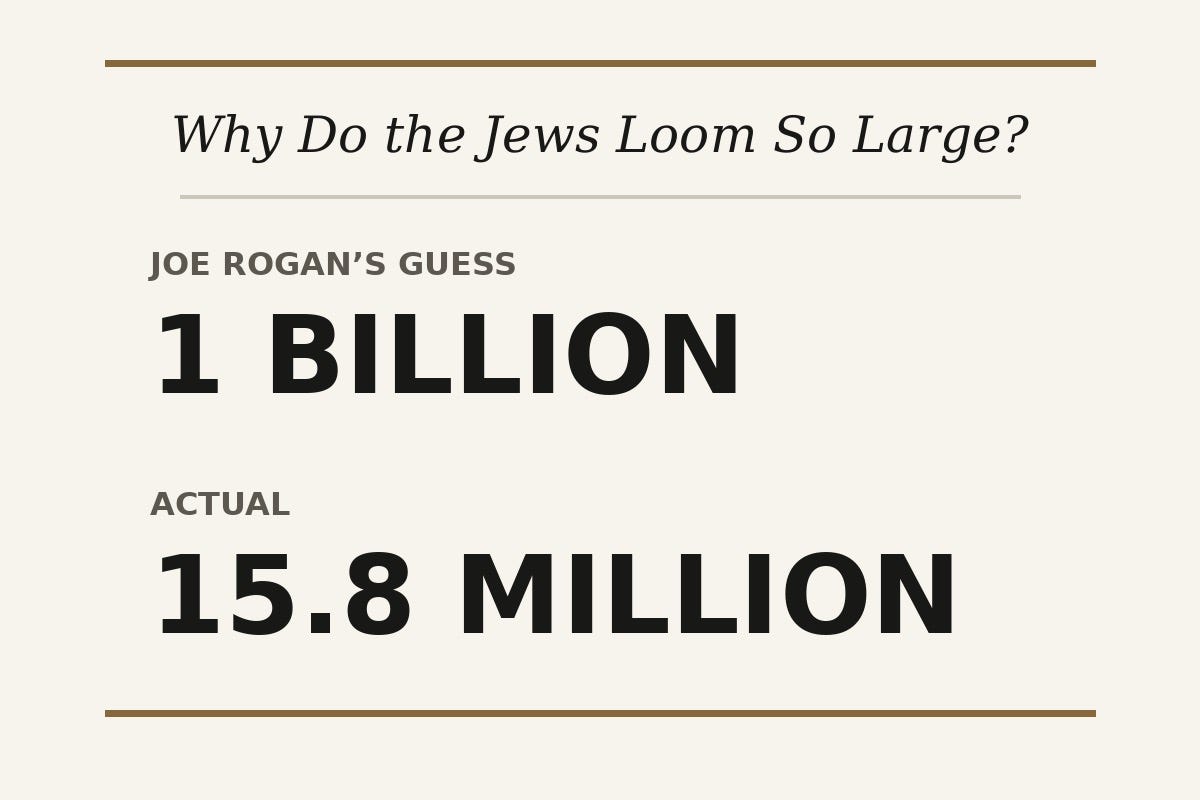
There are fewer Jews in the world than people in metropolitan Tokyo — about 15.8 million, two-tenths of one percent of humanity.
Yet recently, when Gad Saad asked Joe Rogan how many Jews he thought there were in the world, Rogan guessed a billion. Then, reconsidering, he offered what he called a “very conservative guess”: 500 million.
Watch the exchange:
That gap — a tiny people, an enormous shadow — is the puzzle.
Then Michigan Attorney General Dana Nessel sharpened the puzzle. In remarks to a Jewish Democrat caucus, she said Jews may have a “moral imperative” to place “the needs of the world” above “our own survival,” and even to “sacrifice… the very future of our own people” in order to “save the rest of humanity.”
But if so few Jews loom so large, does their survival matter only to Jews?
It is the question I took to our Temple HilMel gathering for Rosh Hashanah, the Jewish new year. The video and text of my remarks are below.
There’s a story Jews have told since the Six-Day War about a young Israeli soldier standing at the newly unified Kotel in Jerusalem, crying.
When someone asked why, he said he was crying because he didn’t understand why he should be crying.
He knew something monumental had happened. He felt part of it.
He just didn’t understand why it meant so much.
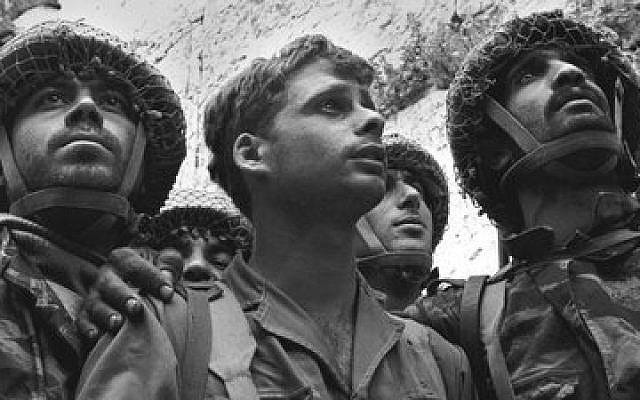
I love that story and wonder whether, almost sixty years later, we’re experiencing similar confusion in our post-October 7th world.
In response to surging antisemitism, Jews have rallied around three words: Am Yisrael Chai!
We know the literal meaning: The people of Israel lives.
But lately, it’s felt like a tribal rallying cry—like “Go Broncos!” Or my personal favorite, “Husker Power!”
And, like my Cornhuskers, I’m afraid the declaration may have lost some of its punch.
What, beyond “We’re not dead yet,” does Am Yisrael Chai mean? What do we want to keep alive?
Those questions seem especially poignant on Rosh Hashanah, when each of us asks to be written into the Book of Life. What would it mean for our people to be written into the Book of Life—and what do we owe for that inscription?
The history of the phrase offers clues.
Emerging first in Zionist literature in the 1890s, Am Yisrael Chai was declared by Rabbi Stephen Wise in 1933 after condemning the Nazis, as if to say: You intend to destroy us. We will live.
Following the liberation of Bergen-Belsen in 1945, a U.S. Army chaplain proclaimed it after survivors sang Hatikvah, as if to say: You tried to destroy us. We still live.
And in 1965, Shlomo Carlebach used it in his famous song about Soviet Jewry, as if to say: You intend to erase Jewish identity. We will live as Jews.
Today, many have something to say about Jews: Who we are. What we believe. What we’re responsible for. What our relationship with Israel should be.
So shouldn’t we ask what we believe about ourselves?
Surely, after thousands of years, Am Yisrael Chai means more than simply surviving.
Yet today, some of the deepest questions about Jewish survival are coming from Jews themselves.
Recently, speaking to a Jewish political caucus, Michigan Attorney General Dana Nessel said Jews have a “moral imperative to place the needs of the world above even our own self-interest and, yes, even our own survival.”
Invoking Queen Esther, she said:
“It is perhaps up to us now to follow in [Esther’s] path and sacrifice the comfort, safety and security and even the very future of our own people in exchange for the opportunity to save the rest of humanity.”
She continued:
“What good is defending the historic homeland of our ancestors and demanding that candidates acknowledge its right to exist if the planet upon which it rests is no longer inhabitable?”
In other words: What good is saving the Jews if we fail to save the world?
Yes, Judaism commands us to care for the stranger, to pursue justice, and to see every human as created b’tzelem Elohim, in the image of God. That is not in dispute. What’s disputable is the ranking.
Esther is not a story about offering the Jewish people so the world can be saved. It is a story about a woman who risked herself so the Jewish people would live.
Esther’s uncle Mordecai’s warning adds another lesson. Esther is living comfortably in the palace when he tells her not to imagine that the palace exempts her from the fate of her people. Comfort is not a release from the covenant.
That is a provocative message for American Jews.
Because we, too, have experienced something historically remarkable in America—not merely tolerance, but genuine belonging.
George Washington told Newport’s Jewish community in 1790 that Jews possessed the same “liberty of conscience and immunities of citizenship” as everyone else.
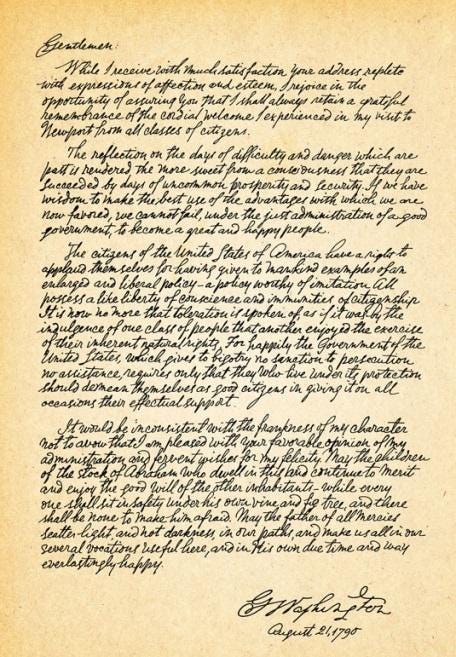
America’s government, he promised, would give “to bigotry no sanction, to persecution no assistance.”
Given such extraordinary acceptance, we’ve become very good at talking about the values Judaism gave the world.
But not so good at saying we have obligations to one another.
Ironically, the society most hospitable to Jews diminishes the need to remember why being Jewish matters.
But Jewish survival isn’t merely a Jewish concern. It’s the Jewish value on which all the others depend. Without Jews to learn them, live them, argue about them and pass them on, eventually there are no Jewish values.
Hillel captured the balance two thousand years ago:
“If I am not for myself, who will be for me? But if I am for myself alone, what am I?”
Hillel’s first clause is not repealed by his second.
Judaism demands both.
A covenant with humanity that no longer includes the covenantal people is the disappearance of Judaism.
It’s Am Yisrael without the chai.
Which brings us to the question underneath all of this:
What exactly are we being asked to keep alive, and why should the world care whether we do?
According to Rabbi Jonathan Sacks, our ancestors understood their relationship with God not as a privilege but as a responsibility.
We were asked to live exceptionally demanding lives—study, justice, charity, responsibility, memory, self-examination, family, community—and those demands shaped us.
A people that teaches its children to read and question produces intellectual capital.
A people that preserves disagreement produces intellectual adaptability.
A people that institutionalizes repentance learns to recover from moral failure.
A people that turns catastrophe into memory learns from experience.
A people that makes hope mandatory keeps building despite enormous obstacles.
And a people that finishes its sacred book as we’ll soon do and immediately returns to Bereshit—“In the beginning”—refuses to believe the story ever ends.
Miraculously, Jews learned to carry all of this with them.
Rabbi Sacks called the Torah “the portable homeland of the Jew.”
The Romans could destroy Jerusalem.
Spain could expel its Jews.
A government could confiscate Jewish property.
A community could be forced to move.
But Jews carried their civilization in their heads.
Torah. Hebrew. Prayer. Calendar. Law. Stories. Family. Memory. Hope.
The Jewish people are small. The ideas they carried are not.
The Hebrew Bible brought ideas of human dignity, the sanctity of life, and a law higher than human power into our founders’ imagination, helping shape 250-year-old American experiment.
And perhaps no Jewish habit has mattered more to our survival than sustaining our memory through stories.
Rabbi Sacks told a story about Napoleon who, walking past a synagogue of weeping Jews on Tisha B’Av, asked why.
“For Jerusalem,” he was told.
“When was Jerusalem destroyed?” Napoleon asked
“More than 1,700 years ago.”
According to the legend, Napoleon replied that a people capable of mourning its homeland after seventeen centuries would surely one day return to it.
Napoleon understood something profound about the Jews.
Jewish memory doesn’t merely preserve the past. It preserves a future.
For nearly two thousand years, Jews ended every Passover seder with L’shanah haba’ah b’Yerushalayim: Next year in Jerusalem.
Memory became hope. Hope became continuity. And eventually, the impossible became possible.
Our challenge in America is different: how do we sustain that continuity when being Jewish is freer—and more optional—than almost anywhere in our history?
Rabbi Sacks put the challenge starkly: “If we do not learn what it is to be a Jew, nothing in our environment, except antisemitism, will tell us.”
That’s why, to ensure chai follows Am Yisrael, we need a reason to want our children to be Jewish—other than that old saw about every Jewish holiday:
They tried to kill us. We survived. Now let’s eat.
In this Shabbat’s Torah portion, Nitzavim, a dying Moses renews the covenant with the people, telling them it binds “those who are not here with us today.”
That means us, and generations after us.
Rabbi Tarfon said the rest: it is not your duty to finish the work, but neither are you free to desist from it.
That is how a 4,000-year-old civilization thinks.
Another story Jews tell captures something profound about Jewish peoplehood.
On a winter death march, a man walked with a child on his back.
Another prisoner rasped, “Put him down. You’ll both die.”
The father did not stop.
“If I put him down,” he said, “I have nothing left to walk for.”
Later someone asked how he had found the strength.
He said:
“You think I am carrying him. He is carrying me.”
The father carried the child. But the future carried the father.
Sometimes the next generation gives this one the strength to take another step.
Perhaps Jews endured because they believed there was still someone—and something—worth carrying forward.
Now, we are the people prior generations were carrying toward.

As the people of Israel, our name tells us what we’re supposed to do with the life they carried toward us.
Our tradition teaches that Jacob became Israel only after wrestling through the night. He emerged wounded and changed, but he refused to let go until he received a blessing -- Israel.
The shofar is our wake-up call: to wrestle with what needs changing—not only in ourselves, but in the world we inhabit.
That’s not only the story of the Jewish people. It’s a challenge to each of us. We’re all wrestling—with choices we wish we’d made differently, with what life has thrown at us, or simply with being Jewish at this moment.
Our task is not just to struggle, but—like Jacob—to emerge changed and blessed: a little wiser, more generous, more purposeful, so that we, in turn, can become blessings to the world.
That’s the answer I’d offer Dana Nessel: We needn’t choose between Am Yisrael Chai and our obligation to humanity. Rather, we keep Am Yisrael alive to continue being a blessing to the world.
Perhaps that’s what it really means for Am Yisrael to be chai.
Perhaps that is also why the young soldier cried at the Western Wall.
He knew he was standing inside something monumental. He could feel the weight of an inheritance he couldn’t yet name, a civilization kept alive by generations of Jews who’d studied it, argued with it, sacrificed for it, rebuilt it, and refused to stop believing it had a future.
They made Am Yisrael Chai true for him, and for us.
Now it is our turn.
Our ancestors carried it to us.
May we prove worthy of carrying it forward.
And may we, and the Jewish people, be inscribed in the Book of Life.
Am Yisrael Chai.