


As a lifelong college football fan, I’ve always found soccer boring. Waiting two hours for the first goal in the World Cup final confirmed it. But I’ve become a fan of soccer fans – and the America they discovered.
Two German visitors, Freddy and Sebastian, went viral after falling in love with America – and not because Americans have air conditioning.
Like millions of World Cup visitors, they expected the America that social media had promised: divided, dangerous, and unwelcoming. Instead, they encountered strangers who stopped to help them, families who welcomed them to their tailgates, and people genuinely curious about them.
“This isn’t what I expected,” Freddy kept saying.
Sebastian just cried. He admitted he was sadder to leave America than he’d been when Germany lost.
They didn’t discover a perfect country. They discovered an exceptionally generous one. That’s why I understood Sebastian’s tears. I shed some as well.
At an America 250 concert, I watched veterans stand as each branch’s anthem played. When the Navy’s — “Anchors Aweigh” — sounded, I lost it, knowing my son Zane would leave for Naval Officer Candidate School within days.
I’m like my grandmother, who cried talking about America. Much of her family was consumed by the Holocaust.
America became her refuge before it became my birthplace. Here, it no longer mattered where she came from. She belonged. So did the family she built.
So, why does America make people cry? By the Fourth of July, I thought I knew the answer. But after two conversations that day, I wondered whether we’d inherited the Founders’ ideals – or merely their holiday.
What She Didn’t Know
While waiting for Aspen’s Fourth of July parade, I fell into conversation with a woman whose children attended school with my son and whose close family member is now campaigning for federal office.
Agreeing that rising antisemitism is a concern, she caught me off guard with:
“October 7th was horrific, but Netanyahu has gone too far.”
Hoping we shared one basic premise – that civilized societies cannot allow terrorists to massacre civilians without consequence – I asked:
“What would you want your government to do after 1,200 people were raped, tortured, and massacred, and hundreds were taken hostage?”
She looked at me quizzically before this exchange:
“They just need to stop fighting and talk.”
“How do you negotiate with terrorists dedicated to your destruction who’ve rejected every peace proposal?”
“I don’t know, but Netanyahu is doing in Gaza what the Nazis did to the Jews.”
After catching my breath, I asked:
“Are you saying Israel is systematically rounding up Palestinians for extermination, the way the Nazis did the Jews?”
She returned to her refrain.
“Too many innocents are dying.”
I queried:
“Isn’t it tragic that so many Arabs living just outside Israel don’t enjoy the same rights, opportunities, and prosperity as Arab Israelis?”
She seemed puzzled:
“I don’t know that to be the case.”
To confirm she knew the facts, I offered:
“Did you know that one-fifth of Israel’s citizens are Arab, that they serve in the Knesset and on Israel’s Supreme Court, and that some were murdered or taken hostage on October 7th?”
To my dismay, she replied:
“I didn’t know there were Arab Israelis.”
I mentioned this cartoon that went viral after October 7th:
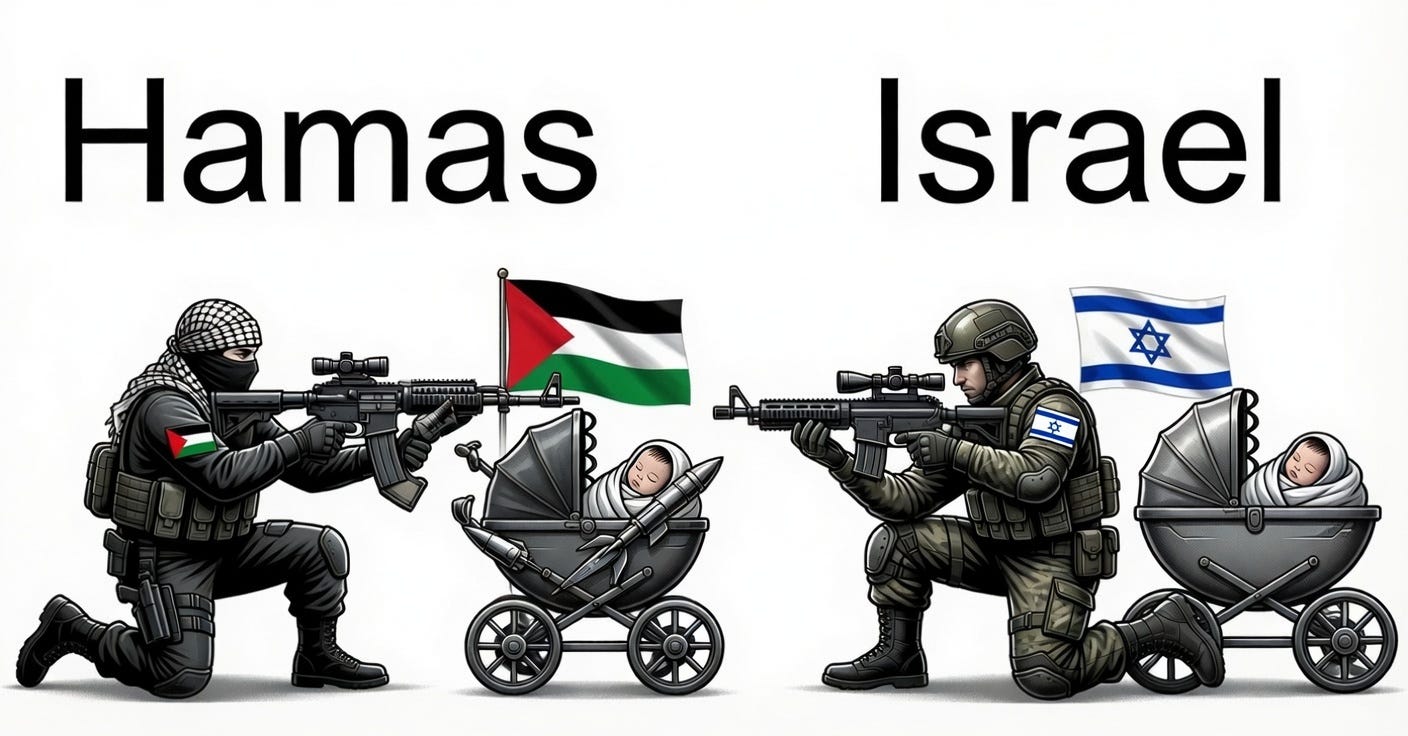
…and asked,
“Shouldn’t we hold Hamas responsible for violating the laws of war by embedding itself among civilians?”
“Yes, it’s an awful dilemma.”
With the parade about to begin, I wanted to end on common ground.
“Many Arab countries now accept Israel because peace serves their interests. Wouldn’t peace be more likely if Palestinians had leaders who believed their own people’s lives mattered too?”
“Yes,” she acknowledged. Then, I couldn’t resist saying,
“To hold such strong opinions, it’s important to be well informed. If I can help with that, let me know.”
“OK.”
I walked away unsettled by how easily any of us can adopt severe moral judgments without considering basic counter-evidence. How can representative government survive when citizens no longer share a common understanding of the facts, and stories repeated relentlessly harden into moral certainties?
Those moral certainties shape not only how we understand the world, but how we see one another — as I would soon discover.
Who Belongs on the Fourth of July?
Aspen’s Independence Day parade has long been one of the town’s most charming traditions. This year, water-spraying was banned, as was my usual candy-tossing, so I rode a float.
As our float rounded a corner, a torrent of water hit us, shattering my sunglasses and drenching me.
A bystander captured the ambush on video and posted it on Facebook, titling it “Pitkin County Republicans assault!” He confirmed no other float was targeted.

I decided to comment:
“Crazy that on the 250th anniversary of the occasion in which Americans pledged their lives, their fortunes and their sacred honor to one another ... I couldn’t ride in a celebratory parade without having my sunglasses demolished by people who couldn’t tolerate opposing political views.”
Alex replied:
“I’m not excusing what happened, it was wrong. But maybe you shouldn’t clutch your pearls while supporting policies that hurt people....”
I wrote:
“The ‘but’ is doing a lot of work. You can’t meaningfully condemn political intimidation while also sneering at the person on the receiving end for objecting to it.”
Alex answered:
“...you’re upset because your uncivil and unconstitutional agenda didn’t receive civility in public.”
I countered:
“Once you label someone’s politics “uncivil” or “unconstitutional,” you appear to think incivility toward them becomes deserved. But millions think the same about your side’s views. That’s why we have elections, courts, legislatures, and persuasion.”
Realizing Alex wasn’t likely to change his mind, I appealed to everyone following our exchange:
“What kind of society do we want: one where people with opposing views can still ride in a public parade without being attacked, or one where political opponents are deemed fair game because someone dislikes their views?”
Readers’ responses heartened me.
But, I went to bed saddened – not because I was criticized online, but because an Independence Day float became a target of intimidation for what it represented.
Shouldn’t the Fourth of July be the one day every American – Republican or Democrat, church or synagogue, native-born or immigrant – can celebrate the inheritance we share?
The Covenant We Inherited
Those two conversations left me asking a different question — not what kind of country we have, but what kind of citizens a free society requires.
America’s inheritance is not just a constitutional republic. It is a covenant among citizens that carries two essential obligations: seek truth before making consequential judgments, and recognize one another as legitimate participants in our shared self-government.
Neglect the first duty, and democracy becomes uninformed. Neglect the second, and it becomes tribal. Neglect both, and government of, by, and for the people begins to unravel.
The Founders’ genius wasn’t to eliminate disagreement — which is impossible. It was creating a system that channeled disagreement into persuasion, elections, legislatures, courts, and the peaceful transfer of power.
The French Revolution also promised liberty and equality, yet it ended with “disagreeables” losing their heads – including Robespierre himself.
That’s because the American experiment began with a remarkable pledge in the Declaration:
Though many Americans were excluded from that promise, the principles themselves contained the seeds of their own fulfillment.
Two centuries later, Martin Luther King Jr. called those principles a promissory note and persuaded America to honor them – not by repudiating the covenant, but by appealing to it.
Today the question isn’t simply how to fulfill that promise. It’s whether we still believe the promise is worth keeping.
Two Visions of America
Two stories now compete for America’s future. One sees our country as fundamentally illegitimate and in need of dismantling. The other calls us to reform and improve it — acknowledging our failures while insisting our founding ideals have done more to advance human freedom than any other experiment in history.
Which story we choose will determine what our children celebrate on America’s Tricentennial.
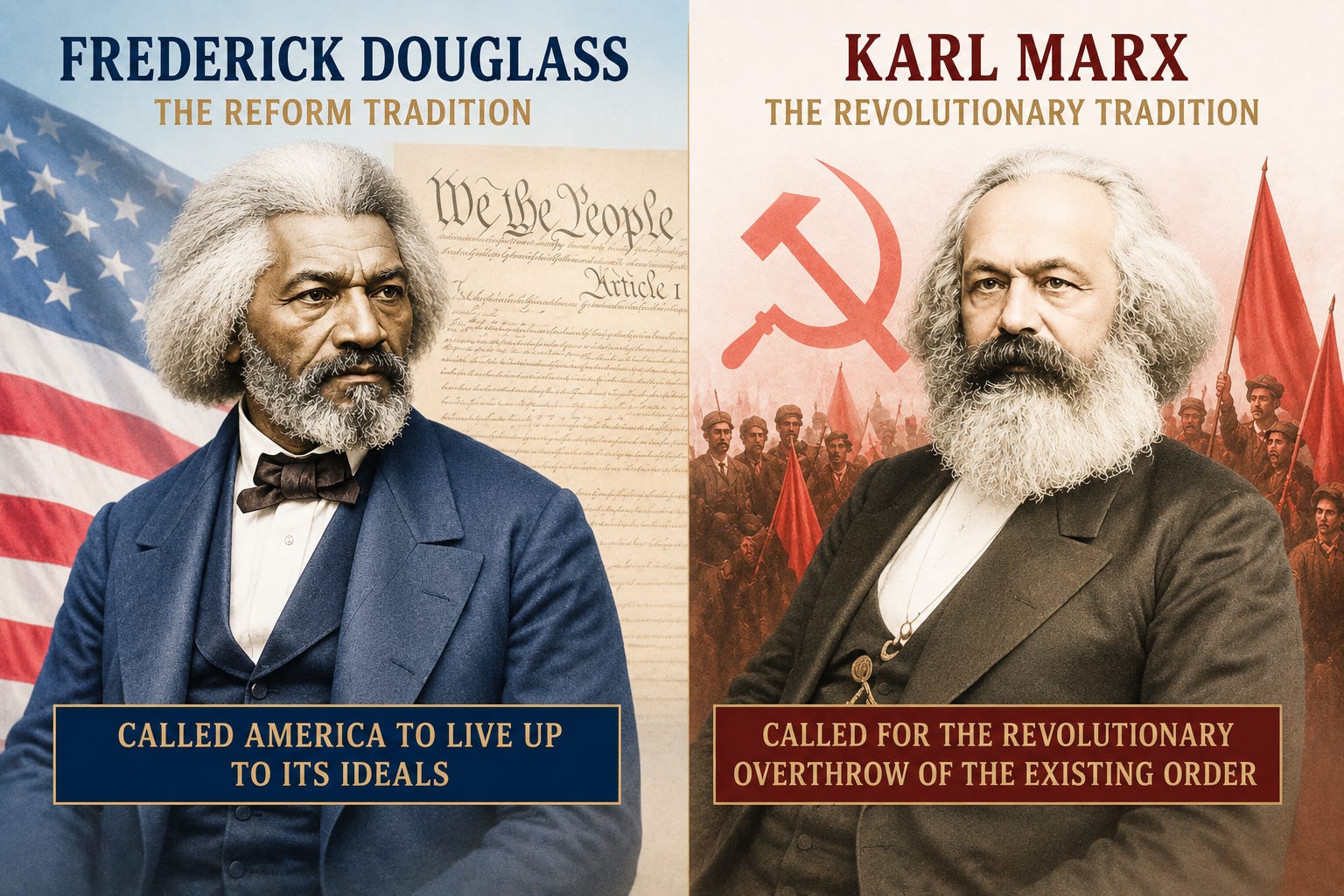
Frederick Douglass and Karl Marx, both born in 1818, embodied these rival visions. One, an escaped slave, called America to live up to its ideals; the other, born into a prosperous family, called for the revolutionary overthrow of the existing order.
Douglass became one of America's greatest reformers. Wherever Marx's ideas were fully implemented, they produced political repression and mass death.
From Reform to Repudiation
The choice between reform and repudiation confronts every generation of Americans.
Today’s most influential advocate for the politics of repudiation is New York City Mayor Zohran Mamdani. His Democratic Socialist movement’s platform calls for replacing core constitutional institutions and for prosecuting American and Israeli leaders for genocide in Gaza.
Last week, Mamdani echoed that same charge personally, accusing Benjamin Netanyahu of genocide and demanding his arrest.
Before accepting Mayor Mamdani's genocide accusation, I encourage readers to spend a few minutes with Arab Muslim Israeli Loud Atia's response and journalist Emily Schrader's fact-check.
As for the DSA, center-left scholar Ruy Teixeira observed:
“It is difficult to find a radical, impractical, unpopular proposal that is not in this platform.”
The DSA’s spirit of repudiation appears in the candidates Mamdani has championed. Claire Valdez, who won her primary, put it bluntly in her platform:
“For decades, we have been sold a lie: that the U.S. empire defends freedom, advances democracy, and protects human rights.”
Unlike Martin Luther King Jr., who appealed to the Declaration to redeem America’s promise, Valdez’s critique begins by rejecting the legitimacy of the American project itself.
Mamdani’s most revealing comment though was not about America or Israel but about citizenship:
“One of the bedrocks of our city is protest.”
Douglass and King used protest to awaken the nation’s conscience and call it back to its covenant — not as a permanent substitute for self-government.
So, is it any wonder that my July 4th conversations unfolded as they did, one marked by uninformed moral certainty, the other by contempt for a perceived enemy?
Reformers, Not Repudiators
The antidote to repudiation is reform. A free republic survives because enough citizens possess the civic virtue to seek truth, question their own assumptions, and refuse to strip others of their moral legitimacy. Fortunately, many Americans are still speaking hard truths to their own side.
Former Obama advisor Van Jones has challenged fellow progressives by asking questions that force them to confront the consequences of their own ideas:
“If we lived in a world where there were no police and no prisons, so that in your neighborhood any gang member, terrorist, pedophile, or Klan member can do whatever they want—is that progress or regress?”
“If we lived in a world where people could literally get elected to office with the only qualification being that they went and celebrated the mass murder of Israelis…is that a better world or a worse world?”
“These are not progressive ideas. These are regressive ideas.”
Watch his monologue here:
Lifelong liberal Bill Maher called out his side recently on ABC’s This Week:
“I’ve read the quotes from the DSA platform, from their own mouths... they say things like takeover of key industries by government — that’s communism. Don’t tell me I’m not seeing what I am seeing.”
His 2028 vote, he added, was “in play.”
After Justice Amy Coney Barrett told Congress that death threats had forced her family to live under armed guard, conservative commentator Erick Erickson rebuked those on the right who attacked her – not the people threatening her life – because she had failed to deliver enough conservative victories. They refuse “to look at the truth,” he wrote, “because the truth is inconvenient to the grievance.”
Though Jones, Maher, and Erickson differ on politics, each challenged his own side —not by demanding conformity, but by insisting that ideas withstand scrutiny. That kind of civic virtue is the opposite of letting stories harden into unexamined moral certainties.
It is also what allows the American covenant to endure.
Now It’s Our Turn
For 250 years, Americans have preserved this covenant — on battlefields, in classrooms, in legislatures, and around family tables — building one of the most successful societies in human history.
That's what the soccer fans discovered: how rare it is to inherit a society where ordinary people are free to pursue meaningful lives. As Americans, we must never take that inheritance for granted.
But the deeper question is not only why America makes us cry. It is whether our children will inherit an America that still inspires grateful tears.
Every July Fourth we celebrate our inheritance with fireworks and flags. But we preserve it by choosing the path of reformers: seeking truth before passing judgment, persuading rather than intimidating, and refusing to make political conformity the price of belonging.
The Founders pledged their lives, their fortunes, and their sacred honor to one another – not because America was perfect, but because they believed her principles were worth sacrificing for.
We are the beneficiaries of that sacrifice. Now it is our turn. May we prove worthy of the inheritance they left us.
Join the conversation! What stories have shaped how you see our American covenant?
Joe - I’m afraid you’re the one who needs to read a book, as well as return your college diploma if you ever got one. Your crude dismissal of 1200 Jewish deaths, along with the rape, sexual mutilation and kidnappings that occurred on 10/7/23 confirms your ugly anti-semitism. In a 2 year war, 70,000 Palestinians civilians are reported killed. That’s 35,000 per year of combat. In WWII, Allied aerial bombing killed 500,000 + German civilians and 400,000 Japanese civilians . 17 million Soviet civilians died from all causes over a 5 year period. WWII and the Gaza War were existential conflicts, a fight to the death. Loss of Palestinian women and children are regrettable, but Hamas and their leaders should have thought about that on Oct 6.
"How do you negotiate durable peace with an organization whose leaders have publicly promised to "repeat the October 7 attack time and again until Israel is annihilated"?
You can't, which is why there won't be peace until Hamas is defeated and there is new leadership of the Palestinians.